

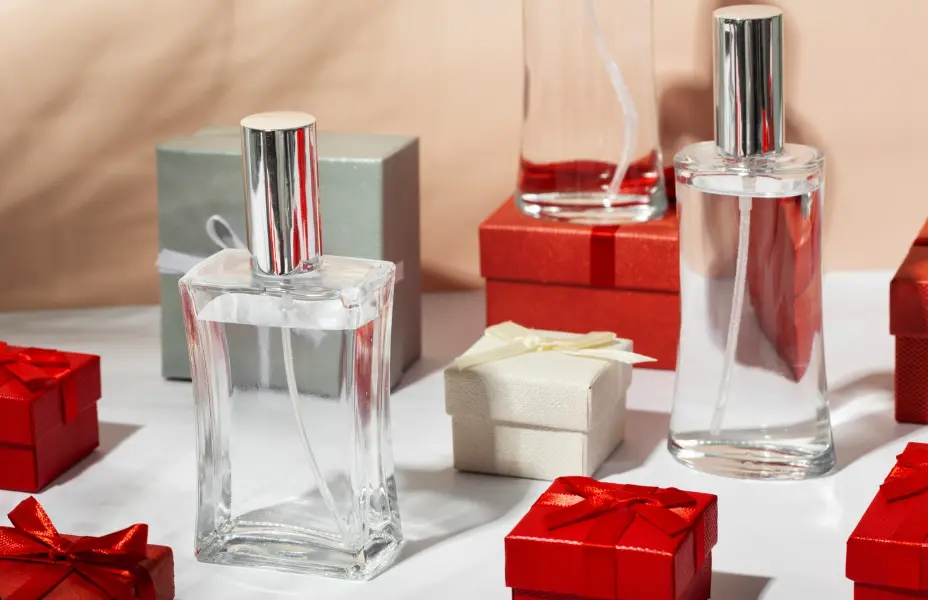
Most people treat perfume refilling as a one-step process: pour and seal. Then they wonder why their fragrance smells flat three months later.
The truth is, refilling is only one-third of the equation. How you store the bottle and how you maintain it over time matter just as much. Get all three right, and a single bottle of your favorite scent can last years. Get one wrong, and you’re throwing money into a drain that smells suspiciously like bergamot.
Here’s what this guide covers:
- How to identify your bottle type before you open anything
- What tools you actually need (and what you can skip)
- Step-by-step refill methods by bottle mechanism
- The storage mistakes that silently degrade your fragrance
- A simple maintenance routine that keeps the spray working like new
- How to tell when a perfume has turned and when it’s time to retire the bottle
Does Your Bottle Type Change How You Refill It?
Yes, and this is the part most guides skip straight past.
There are three main perfume bottle types you’ll encounter, and each one requires a different approach. Misidentify yours, and you risk damaging the collar, cracking the seal, or worst case, snapping the spray mechanism off entirely.
Screw cap bottles are the most forgiving. The cap threads off counterclockwise, the opening is accessible, and you can refill with minimal tools. Easy.
Snap-fit (press-fit) bottles are trickier than they look. The cap presses onto the bottle base or neck with a friction seal. You need leverage applied at the seam, not force applied to the center. A butter knife wrapped in a cloth works better than anything sharp.
Crimped collar bottles are the most common in luxury and designer fragrances. The metal collar is literally pressed around the bottle neck using industrial equipment. Opening one at home is doable but it requires care, the right tools, and patience. We cover the exact method below.
Not sure which type you have? Check the neck of the bottle carefully before you start. The collar tells you everything.
What Tools Do You Actually Need?
Here’s an honest answer: not many.
Competitors will hand you a ten-item shopping list. In practice, most refills only require three or four things and you likely own half of them already.
Tool | When You Need It | Priority |
Small syringe or pipette | For precise transfer into narrow openings | High |
Isopropyl alcohol (70%+) | Cleaning between scents or after spills | High |
Lint-free cloth or tissue | Wiping the neck and collar after filling | High |
Needle-nose pliers (tape-wrapped) | Crimped collar bottles only | Situational |
Small funnel | Wider-mouth bottles only | Low |
Gloves | Handling stubborn crimped collars | Optional |
One note on funnels: they’re often recommended as the default tool, but for most modern perfume bottles, a small syringe gives you far more control. It minimizes air exposure during transfer, which matters more than most people realize. Oxygen is what starts the oxidation clock ticking.
How to Refill a Perfume Bottle (By Bottle Type)
Before you do anything else: clean the bottle if you’re switching fragrances. Rinse with isopropyl alcohol, then let it dry completely. Skipping this step means your new scent will carry ghost notes from the old one. Nobody wants to wear “Sauvage with hints of last season’s rose.”
Screw Cap Bottles
- Grip the glass body firmly not the cap itself.
- Twist the cap counterclockwise slowly. If it’s stuck, wrap a cloth around it for grip. Never use heat to loosen it.
- Lift the cap off. If there’s a separate stopper in the neck, remove it gently with a lint-free cloth.
- Use your syringe to draw perfume from the refill source and dispense it steadily into the bottle. Fill to about 90% capacity leave room for the spray mechanism.
- Replace the stopper first, then screw the cap back on until snug. Not tight enough to strip the threads, but tight enough that you’d notice if it loosened.
Snap-Fit Bottles
- Examine the seam where the cap meets the bottle neck. You’re looking for a small notch or gap.
- Insert the tip of a cloth-wrapped butter knife into that gap.
- Apply gentle rotational pressure, not a pry, a twist. The snap seal should release with a soft click.
- Refill using the syringe method above.
- Press the cap back down firmly and evenly until you hear it seat. Test by trying to lift it, it should resist.
Crimped Collar Bottles
This is where most DIY refills go wrong, so take your time.
- Wrap the jaws of needle-nose pliers with tape or cloth to protect the bottle.
- Grip the metal collar just below the spray actuator not the actuator itself.
- Rock the pliers gently side to side. You’re loosening the crimp, not ripping it off. This takes patience, especially on older bottles.
- Once the collar moves freely, lift the entire spray mechanism (collar + actuator) straight up and off.
- Refill using a syringe directly into the bottle opening.
- Re-seat the spray mechanism. Press it down firmly and evenly.
If you can’t re-crimp the collar securely at home, which is likely, since the original crimping required specialized equipment, use a thin strip of plumber’s tape wrapped around the neck as a temporary seal, then take it to a perfume boutique or fragrance counter for professional re-crimping. Many department stores offer this service. You can also find specialist refill services that handle exactly this situation.
For a detailed walkthrough specific to designer bottles, this step-by-step guide covers brand-specific considerations worth checking before you start.
The Right Way to Store Perfume, According to Olila Package
Storage is where most people lose the battle without realizing it.
The standard advice “keep it in a cool, dark place” is correct but woefully incomplete. Here’s what actually matters.
Temperature is the biggest factor. Perfume degrades fastest under heat fluctuation, not just heat itself. A consistently cool environment (ideally below 15°C / 59°F) is better than one that swings between warm and cold. That rules out most bathroom cabinets, window sills, and car gloveboxes.
The bathroom is the single worst place to store perfume. Yes, it’s where most people keep it. The combination of steam, temperature spikes, and ambient moisture accelerates oxidation faster than almost anything else. A bedroom drawer or closet shelf is meaningfully better.
Light degrades top notes first. UV exposure breaks down aromatic compounds, and the first casualty is always the bright citrus and floral top notes that you smell when you first spritz. Keep bottles away from direct sunlight and out of glass-fronted cabinets that face windows.
Store bottles upright. When a bottle sits on its side, the perfume makes contact with the stopper or seal for extended periods. Over time, this causes micro-leakage and increases evaporation. Upright is always correct.
Label your refill date. This sounds minor. It isn’t. Most Eau de Parfums show a noticeable scent shift within 12 to 24 months of opening, regardless of storage quality. This is a natural result of oxidation, not a sign that something went wrong. If you don’t know when you opened or refilled a bottle, you can’t track this. A small sticker on the base with the date takes five seconds and saves real confusion later.
How to Keep the Bottle and Spray Mechanism in Good Condition
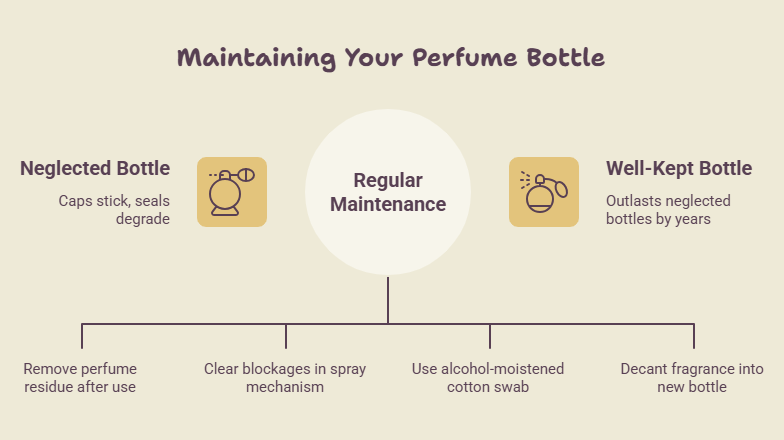
Maintenance is the section every competitor skips. It’s also where a well-kept bottle outlasts a neglected one by years.
After every use, wipe the neck. Perfume residue builds up around the collar and cap threads. Left long enough, it causes caps to stick, seals to degrade, and on crimped bottles, collar corrosion. A quick wipe with a dry cloth takes two seconds.
If the spray starts to sputter or mist unevenly, the actuator or dip tube is likely partially blocked. Remove the spray mechanism and rinse the actuator head under warm water. For stubborn blockages, soak briefly in isopropyl alcohol. Do not blow into the nozzle this introduces moisture and contaminants directly into the bottle.
If residue builds up around the neck, clean it with a cotton swab moistened with alcohol. Dry it thoroughly before replacing the cap. This one habit prevents the majority of sealing problems.
Know when to retire a bottle. If the glass has developed a visible crack, the collar is bent or damaged beyond re-seating, or the stopper no longer creates a proper seal, the bottle itself is the problem. At that point, no amount of refilling will preserve your fragrance. Decant into a clean alternative bottle, or accept the run is over.
5 Perfume Refilling Mistakes Worth Avoiding
These come up again and again, and each one is completely avoidable.
- Forcing open a non-refillable bottle. Some spray mechanisms are permanently sealed and simply cannot be removed without destroying the collar. If the mechanism won’t move after proper technique, stop. The bottle isn’t designed for DIY refilling.
- Using a wide funnel for a small opening. Longer air exposure during transfer means more oxidation. A syringe is cleaner, faster, and more precise for narrow openings.
- Skipping the cleaning step when switching scents. Residual fragrance doesn’t disappear it merges with the new one. The result is rarely pleasant.
- Mixing fragrance concentrations. Adding an Eau de Toilette into a bottle originally holding an Eau de Parfum changes the overall concentration and, by extension, the scent throw and longevity. Stick to like-for-like when possible.
- Storing on a bathroom vanity. We know it looks good there. It’s still the worst place in your home for a perfume bottle.
How Do You Know If a Stored Perfume Has Gone Bad?
Three signs to watch for:
- The top notes smell sharp, sour, or metallic. This is oxidation affecting the most volatile aromatic compounds first.
- The liquid has darkened noticeably. Some color shift is normal over years, but a dramatic change in color usually indicates significant chemical change.
- The dry-down smells flat or chemical-like. The base notes are the last to go. When they’re affected, the fragrance is genuinely past its best.
A turned perfume cannot be restored by refilling. The degradation is chemical, not a volume problem.